
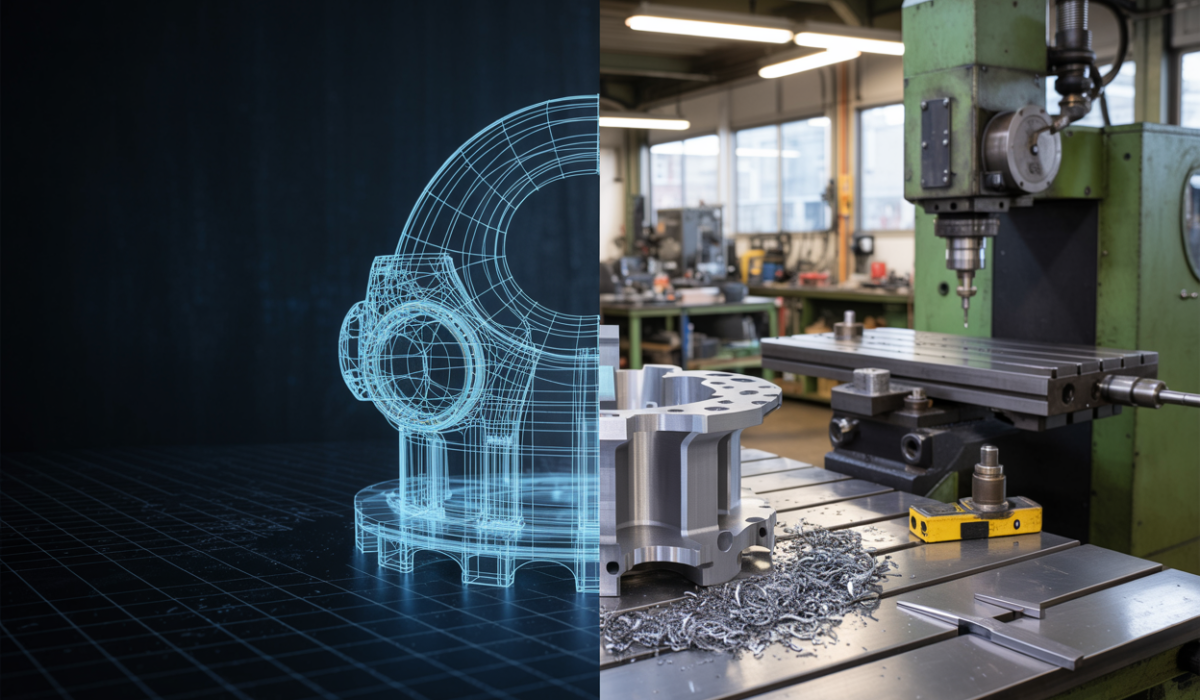
Why “Manufacturable” Designs Still Fail And What Manufacturing Teams See That CAD Never Shows
In modern product development, very few designs reach manufacturing without review.
CAD models are clean. Simulations converge. Design-for-Manufacturing (DFM) reviews are completed and signed off.
And yet, many of these same designs still struggle once they reach the shop floor.
Parts technically meet drawing requirements but are difficult to assemble. Lead times stretch without an obvious cause. Quality issues appear only after multiple builds, even though nothing on the drawing seems “wrong.”
This disconnect highlights a difficult but common truth in advanced manufacturing:
A design can be manufacturable on paper and still fail in production.
The difference lies not in engineering competence, but in the gap between idealized design environments and real manufacturing systems. It is a gap that CAD tools, simulations, and even structured DFM reviews cannot fully close on their own.
The quiet limits of CAD and simulation
Modern engineering tools are extraordinarily powerful. They allow teams to visualize complex geometry, evaluate stress, simulate flow, and validate interference with impressive accuracy.
What they cannot do is represent manufacturing as it actually happens.
CAD and simulation assume perfect geometry, perfect alignment, and perfectly repeatable processes. Manufacturing, by contrast, is shaped by variation — in materials, tooling, machines, operators, and time.
A design that appears robust in a digital environment can become surprisingly fragile once it is exposed to:
- normal process variation,
- tool wear and setup differences,
- material behaviour across batches,
- and the realities of human assembly and inspection.
None of these invalidate the design. They simply reveal that design correctness does not equal production robustness.
Why “DFM approved” is not the same as “production ready”
DFM reviews play an important role in preventing obvious problems. They help identify unmachinable features, inaccessible tooling paths, or unrealistic tolerances.
But most DFM processes are, by necessity, scoped narrowly. They focus on whether a part can be made — not how reliably, repeatedly, or economically it will be made at scale.
What tends to sit outside formal DFM reviews are issues like tolerance interaction across multiple processes, fixturing repeatability, assembly sequencing, and inspection practicality. These are not binary pass-fail criteria. They are system behaviours that only emerge through repetition.
As a result, many designs pass DFM yet struggle in production — not because DFM failed, but because DFM alone cannot capture manufacturing reality in full.
Where designs actually begin to struggle
Most production challenges do not announce themselves dramatically. They surface gradually, often in ways that are difficult to trace back to a single design choice.
One of the most common examples is tolerance behaviour. Individually, dimensions may be well within specification. Collectively, small variations accumulate across parts, fixtures, and assemblies until alignment becomes inconsistent or functional margins shrink.
Another frequent source of friction is fixturing. CAD assumes ideal workholding, but every real part must be located, clamped, supported, and released. If a design does not naturally lend itself to stable, repeatable fixturing, manufacturing complexity increases — along with variability.
Tool access presents similar challenges. Features that are technically machinable may require long tool reaches, interrupted cuts, or marginal stability. These conditions may not prevent production, but they reduce yield, increase wear, and make outcomes less predictable.
Assembly is often where all of these issues converge. Designs that assemble smoothly in the hands of the designer may behave very differently when assembled repeatedly by different operators, under time pressure, using production tooling. Human factors matter, and they are difficult to model.
Finally, inspection is frequently underestimated. Every critical feature must be measurable — not just in theory, but with available equipment, by different inspectors, and within reasonable cycle times. Designs that are difficult to inspect create blind spots that allow variation to escape downstream.
Why experience still matters — even with modern tools
Manufacturing knowledge is not just technical; it is experiential.
Experienced manufacturing teams develop intuition about which designs will behave well in production and which will struggle — even when drawings look correct. This intuition is built from patterns observed across many builds, materials, machines, and programs.
It includes an understanding of how tolerances drift over time, where manual intervention tends to creep in, and which assemblies are sensitive to small deviations. These insights are difficult to encode into rules, but they are critical to production success.
At CIMtech Green Energy MFG. Inc., manufacturability is evaluated through this production-reality lens. Designs are not assessed solely on whether they can be made, but on how consistently they can be produced, assembled, and inspected over time.
Where production-intent builds change the conversation
The most effective way to expose manufacturing reality early is through production-intent builds.
These are not prototypes in the traditional sense. They use real materials, realistic tolerances, planned processes, and actual inspection methods. Volumes are intentionally limited, but the learning value is high.
It is during these builds that teams often discover which assumptions hold — and which do not. Tolerance interactions become visible. Assembly sequences reveal friction. Inspection challenges surface quickly.
Crucially, these discoveries happen while designs are still flexible and change is manageable.
Manufacturability is a system outcome
One of the most persistent misconceptions in product development is that manufacturability is a property of a part.
In reality, manufacturability emerges from the interaction of many elements: design decisions, process selection, equipment capability, operator interaction, quality systems, and supplier constraints.
Optimizing any single element in isolation rarely leads to smooth production. It is the alignment between elements that determines whether manufacturing is predictable or painful.
This is why a drawing that looks sound in isolation can still struggle once it becomes part of a real manufacturing system.
Why production readiness must be demonstrated
Many organizations treat DFM sign-off as a milestone that signals readiness for production.
In practice, it is only a checkpoint.
True production readiness is demonstrated through behaviour: stable processes, repeatable outcomes, predictable assembly, and inspectable quality. These attributes are proven over builds, not declared in reviews.
Manufacturing problems rarely appear as single, dramatic failures. They emerge as slow ramps, inconsistent quality, unexpected rework, and missed delivery dates — all symptoms of designs that were manufacturable in theory but fragile in practice.
The value of early manufacturing partnership
Manufacturing partners are often engaged after key design decisions are already locked. By that point, options are limited and trade-offs become expensive.
When manufacturing expertise is integrated earlier, teams gain insight into real process capability, cost and lead-time drivers, and risk concentration. This input does not constrain design — it strengthens it.
At CIMtech Green Energy MFG. Inc., early manufacturing involvement during new product introduction is used to surface real-world constraints before designs are frozen, helping reduce late-stage changes and improve overall production confidence.
Final thought
Modern engineering tools are indispensable — but they do not replace manufacturing reality.
Designs fail not because engineers are careless, but because manufacturing is complex, variable, and human. The gap between CAD and the shop floor is closed through experience, early production-intent builds, and honest feedback from those who build parts every day.
In advanced manufacturing:
Manufacturability is not a box to check.
It is a capability to prove.