
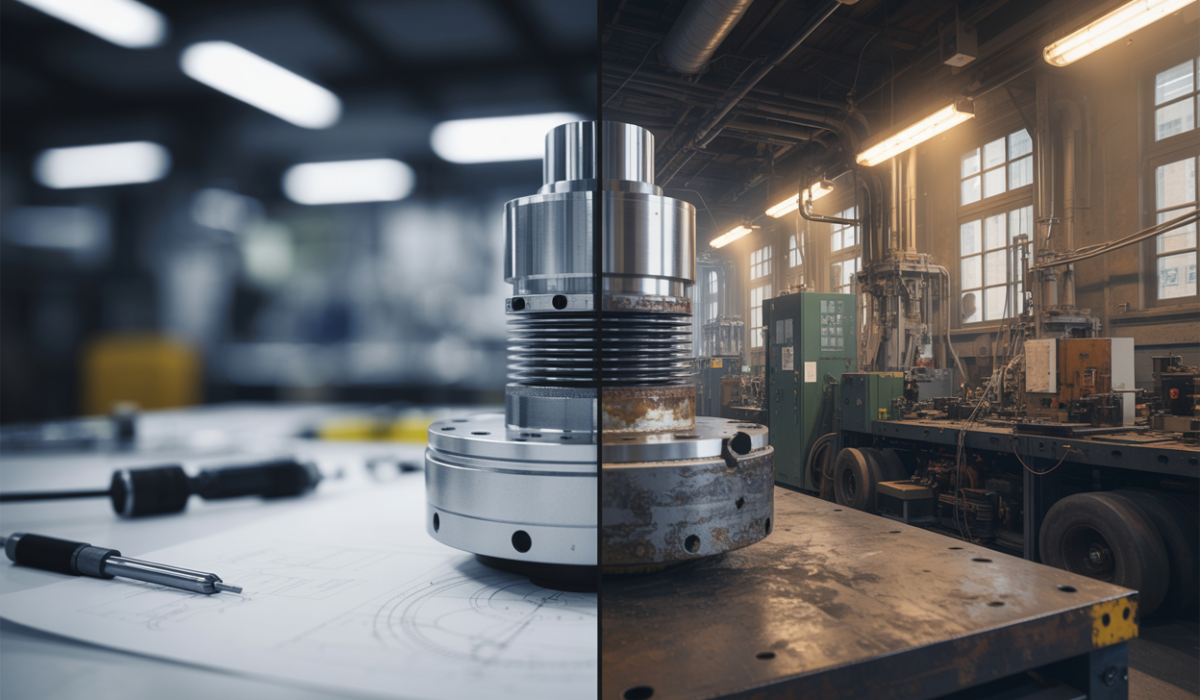
From Prototype to Field Deployment: The Hidden Manufacturing Risks That Kill Clean-Energy Hardware
The biggest risks in prototype-to-production clean-energy manufacturing rarely appear in the lab. They surface later—during scale-up, early production, or field deployment—when hidden material, tolerance, tooling, and assembly issues begin to compound.
Most clean-energy hardware does not fail dramatically.
It passes initial testing.
It demonstrates performance in controlled environments.
It secures pilot customers and funding.
Then it stalls—quietly—when manufacturing reality arrives.
In clean energy, this gap between technical success and commercial deployment has become one of the most common failure points. And it is rarely caused by bad engineering. More often, it is caused by manufacturing risk that was never fully exposed early enough.
The prototype illusion
Prototypes are essential. They validate concepts, de-risk core technologies, and allow teams to test assumptions quickly. Without prototypes, innovation would slow to a crawl.
But prototypes can also create a false sense of confidence.
A successful prototype proves that something can work. It does not prove that it can be manufactured repeatedly, economically, or reliably under real-world conditions.
In clean-energy hardware development, prototypes frequently rely on:
- One-off or specialty materials
- Hand-finished or loosely controlled tolerances
- Manual assembly by experienced engineers
- Test environments that do not reflect long-term operation
These shortcuts are understandable early on. Speed matters. Budgets are constrained. The focus is on proving feasibility.
The problem arises when prototype success is interpreted as manufacturing readiness.
What often emerges during NPI
Clean-energy prototypes may meet functional requirements in laboratory settings, but manufacturing risks—such as tolerance accumulation, assembly access, thermal distortion, or material variability—frequently surface only during low-volume, production-intent builds.
At that point, changes are slower, more expensive, and more disruptive.
Why clean-energy hardware is uniquely vulnerable
Manufacturing risk exists in every industry, but clean energy amplifies it.
Clean-energy systems often operate under:
- Pressure cycling and thermal loading
- Continuous or near-continuous duty cycles
- Vibration, corrosion, and environmental exposure
- Long service lifetimes (often 10–20 years)
- Safety-critical and regulated conditions
Electrolyzer balance-of-plant components, fuel-cell assemblies, power-electronics enclosures, and hydrogen handling systems are unforgiving of small errors. A tolerance issue that seems insignificant in a prototype can become a leak path, fatigue initiator, or reliability concern in the field.
Unlike consumer products, failures here are not cosmetic. They affect:
- System uptime
- Maintenance costs
- Regulatory compliance
- Customer trust
- Brand credibility
Many failures do not occur immediately. They appear months or years later, when remediation is costly and reputational damage is difficult to reverse.
Five manufacturing risks that appear too late
1. Material availability and behaviour at production volumes
Materials selected during prototyping are often chosen for performance, not manufacturability.
At scale, teams may discover:
- Long lead times or limited suppliers
- Inconsistent batch properties
- Unexpected machining or forming challenges
- Cost structures that do not scale
In clean energy, materials are frequently exposed to pressure, temperature, and chemical environments that magnify variability. What performs well in a single prototype may behave differently across repeated production runs.
2. Tolerance stack-ups and dimensional stability
Prototypes are often assembled with care, experience, and manual adjustment. Production does not enjoy that luxury.
Tolerance stack-ups occur when small dimensional variations accumulate across multiple parts and processes. Individually, each part may be within specification. Together, they may create:
- Misalignment
- Leaks
- Uneven loading
- Premature wear
In clean-energy hardware, tolerance issues are particularly dangerous because they can affect sealing, flow, electrical isolation, and structural integrity.
3. Tooling and process assumptions
Designs optimized for prototyping often ignore tooling realities.
Features that appear harmless in CAD—tight internal corners, deep pockets, complex geometries—can become costly or unstable in production. When tooling is introduced late, teams are forced to choose between redesign and compromise.
Both options carry risk.
4. Assembly complexity and human factors
A product that assembles easily in the hands of its designer may be far more challenging on the shop floor.
Common issues include:
- Poor access to fasteners
- Tight assembly sequences
- Excessive manual alignment
- High sensitivity to operator technique
In clean-energy systems, assembly quality directly affects performance and reliability. Complexity increases variability, and variability increases risk.
5. Field serviceability and lifecycle considerations
Many manufacturing risks do not reveal themselves until after deployment.
Designs that overlook:
- Inspection access
- Maintenance procedures
- Replacement of wear components
- Disassembly and reassembly
can turn minor issues into major operational problems. In infrastructure-grade clean-energy systems, serviceability is not optional—it is essential.
The cost curve of late discovery
One of the most important—and least visible—realities in manufacturing is the cost of late discovery.
Issues found:
- During prototyping are relatively inexpensive to fix
- During early production are disruptive but manageable
- After field deployment are costly, slow, and reputationally damaging
Every stage downstream multiplies the impact of change. In clean energy, where margins are often thin and timelines tight, late surprises can stall entire programs.
Bridging the gap with production-intent manufacturing
The most effective way to manage manufacturing risk is not to eliminate prototyping—it is to complement it with production-intent manufacturing earlier.
Production-intent manufacturing means:
- Using real materials
- Applying production-grade tolerances
- Employing repeatable processes
- Following realistic inspection and quality controls
These builds are typically low in volume, but high in learning value.
They expose issues that simulations, prototypes, and lab tests often miss.
Manufacturing as a design input, not a downstream step
The clean-energy programs that transition most smoothly from prototype to field deployment tend to share one characteristic: manufacturing is involved early.
Manufacturing is treated as a design constraint, not a post-design activity.
At CIMtech Green Energy MFG. Inc., early manufacturing involvement is used to expose real-world constraints before design freeze—providing feedback on tolerances, materials, process feasibility, and assembly considerations while changes are still manageable.
This integration does not slow innovation. It accelerates it—by preventing late-stage rework and false starts.
The role of low-volume production builds
Low-volume production builds serve a critical purpose in clean-energy hardware development.
They allow teams to:
- Validate manufacturability without committing to scale
- Test inspection and quality processes
- Identify assembly bottlenecks
- Observe part-to-part variation
- Refine documentation and work instructions
These builds are often the first time a design encounters true manufacturing reality.
Quality systems matter earlier than expected
Another common misconception is that robust quality systems are only necessary at scale.
In reality, quality systems matter earlier, especially in clean energy.
Even at low volumes, controlled inspection, traceability, and documentation:
- Reveal process variability
- Support root-cause analysis
- Enable consistent learning across builds
Skipping these steps early often leads to repeating the same mistakes later—at higher cost.
Supply chain risk is manufacturing risk
Manufacturing does not happen in isolation.
Supplier capability, material availability, and logistics all influence manufacturability. Clean-energy programs that delay supplier engagement often discover constraints too late.
Early manufacturing involvement helps surface:
- Supplier limitations
- Alternative material options
- Lead-time drivers
- Cost sensitivities
These insights inform better design and sourcing decisions long before scale.
Why early manufacturing reality matters
Every manufacturing issue discovered after launch costs exponentially more to fix.
Early manufacturing realism saves:
- Time
- Capital
- Engineering bandwidth
- Customer confidence
For clean-energy hardware, the fastest path to market is rarely the one with the fewest prototypes—it is the one with the earliest manufacturing truth.
Frequently Asked Questions
Why do clean-energy prototypes fail in production?
Because prototypes often use non-production materials, loose tolerances, or manual assembly, masking real manufacturing issues.
What is a production-intent prototype?
A build that uses the same materials, tolerances, processes, and inspection methods planned for production.
When should manufacturing be involved in product development?
Before design freeze. Early involvement reduces rework, delays, and cost.
What manufacturing risks are most common in clean energy?
Material availability, tolerance stack-ups, tooling constraints, assembly complexity, and poor serviceability.
How can companies reduce manufacturing risk before scaling?
By running controlled low-volume production builds and validating manufacturing assumptions early.
Final takeaway
Clean-energy hardware rarely fails because the technology does not work.
It fails because manufacturing reality arrives too late.
The organizations that succeed are those that confront manufacturability early—while designs are still flexible, costs are still manageable, and learning is still fast.
In clean energy, manufacturing readiness is not the final step of innovation—it is part of innovation itself.