
Manufacturing at the Speed of the Energy Transition: Why Agility Now Matters More Than Scale
Agile manufacturing for clean energy means producing production-intent components at low to medium volumes so hydrogen and clean-technology companies can adapt quickly, reduce capital risk, and accelerate deployment during the energy transition.
For much of the past decade, clean-energy manufacturing followed a familiar script. Scale was the objective. Gigafactories, high-volume tooling, and aggressive production forecasts dominated planning discussions. The underlying assumption was straightforward: demand would arrive quickly, technologies would stabilize, and manufacturers needed to be ready in advance.
In 2026, that assumption no longer reflects reality.
Across hydrogen, fuel cells, advanced power systems, energy storage, and electrification infrastructure, companies are navigating uncertain policy timelines, evolving technical standards, fluctuating incentives, and unpredictable customer demand. Projects move forward, pause, restart, and pivot. Designs evolve longer than expected. Commercialization timelines stretch.
In this environment, manufacturing agility—not sheer scale—has become the true competitive advantage.
The limits of scale-first manufacturing in clean energy
Scale-first manufacturing works best when three conditions are met: mature designs, stable markets, and predictable demand. Clean energy rarely satisfies all three at the same time.
Many OEMs and system developers encounter similar challenges when scale is pursued too early:
- Capital committed to tooling before designs are fully validated
- Long lead times that slow engineering iteration
- Overcapacity risk when projects are delayed, re-scoped, or cancelled
- Supply chains optimized for volume, not flexibility
Early scale often introduces friction between engineering and manufacturing. Engineering teams need freedom to refine performance, reliability, and cost. Manufacturing operations need stability, repeatability, and frozen designs.
When scale is introduced before designs are ready, trade-offs are often forced too early. Design decisions are locked not because they are optimal, but because changing them would disrupt tooling, schedules, or suppliers.
In clean energy, those compromises can have cascading effects—missed deployment windows, extended pilot phases, reliability issues in the field, and lost confidence among customers and investors.
Why agile manufacturing is now a competitive advantage
Agile manufacturing shifts the focus from volume to learning, adaptability, and controlled risk.
Rather than betting on a single future scenario, agile approaches allow companies to:
- Iterate designs without sacrificing quality
- Support multiple programs and customers in parallel
- Reduce financial exposure during early commercialization
- Generate real manufacturing data before scale decisions
Instead of asking, “How do we make a million of these?” agile manufacturing asks, “How do we make the next fifty better—and faster?”
This mindset aligns far more closely with how clean-energy technologies actually mature: through incremental validation, feedback from real manufacturing processes, and gradual confidence building.
What agile manufacturing looks like in practice
Agile manufacturing is not prototyping, and it is not mass production. It occupies the critical space between the two.
Key characteristics include:
- Low-volume, production-intent manufacturing
- Precision CNC machining and hybrid manufacturing approaches
- Short feedback loops between design, manufacturing, and testing
- Repeatable quality systems, even at modest volumes
Parts produced through agile manufacturing are built to operate under real conditions. They are not lab samples or demonstration units. They are components expected to withstand pressure, temperature cycling, vibration, and extended duty cycles.
Practical application in clean energy
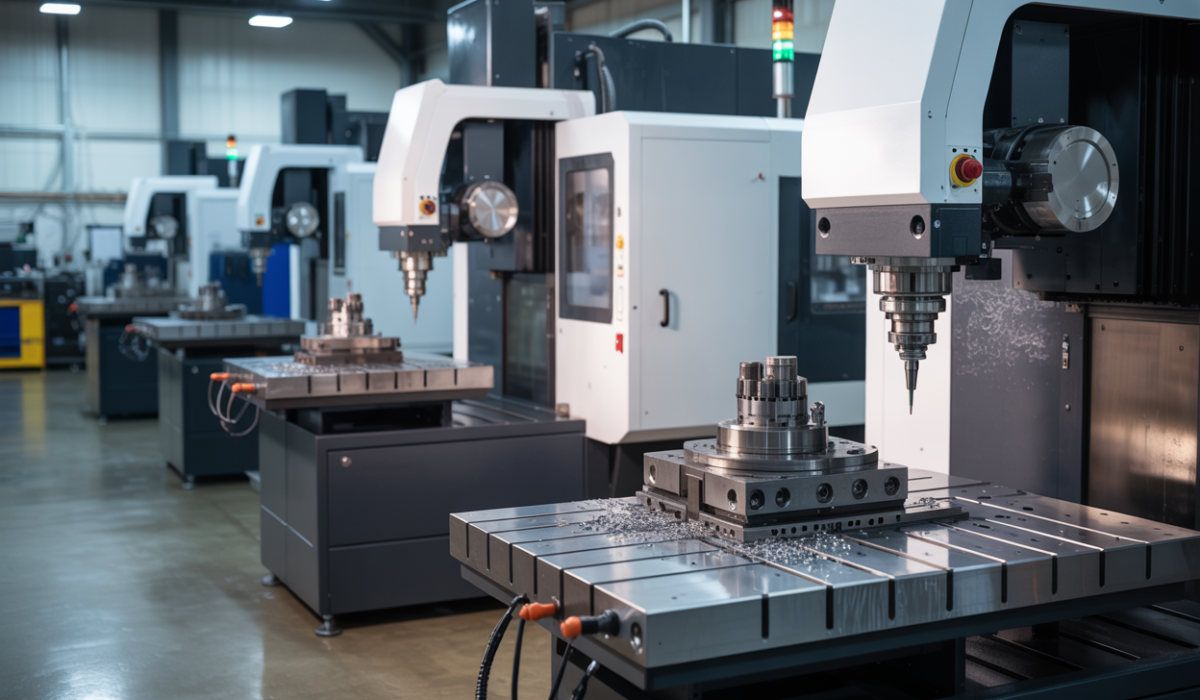
In many clean-energy programs, early manufacturing focuses on low-volume, production-intent components to validate design assumptions under real machining, inspection, and assembly conditions. These controlled builds allow engineering teams to iterate quickly while maintaining manufacturing discipline and repeatability.
This phase often reveals insights that simulations and prototypes alone cannot: how materials behave when machined repeatedly, where tolerances accumulate, how assemblies come together on the shop floor, and where service access becomes constrained.
Why hydrogen and clean-energy hardware demand agility
Clean-energy systems operate in demanding environments:
- Pressure cycling and thermal loading
- Continuous or near-continuous duty cycles
- Vibration, corrosion, and environmental exposure
- Safety-critical operating conditions
Electrolyzer balance-of-plant components, fuel-cell manifolds, precision housings, and power-electronics enclosures must meet production-level standards early in their lifecycle. At the same time, designs continue to evolve as teams refine efficiency, durability, and cost targets.
Agile manufacturing enables teams to validate designs under real operating conditions—without prematurely committing to expensive tooling or inflexible processes.
Agility supports better engineering decisions
One often overlooked benefit of agile manufacturing is how it improves decision-making upstream.
By producing real parts early, teams gain:
- Accurate cost drivers
- Real tolerance behaviour
- Assembly and service insights
- Supplier and process constraints
This information enables better design trade-offs long before commercialization pressure mounts. Engineering decisions become grounded in manufacturing reality rather than assumptions.
The role of bridge manufacturers
Between the lab and full-scale production lies a gap where many clean-energy programs struggle. This gap is often addressed by manufacturers who operate as bridges between innovation and scale.
At CIMtech Green Energy MFG. Inc., manufacturing is often integrated during new product introduction to provide early feedback on tolerances, materials, and process feasibility—before designs are locked for scale.
This bridge-builder role allows clean-energy teams to move forward with greater confidence, even when market timelines, funding cycles, and policy signals remain uncertain.
Nearshoring, resilience, and speed
Agility is closely tied to supply-chain resilience. Clean-energy OEMs increasingly prioritize:
- Shorter lead times
- North American manufacturing partners
- Reduced geopolitical and logistics risk
Manufacturers with in-house capabilities and strong domestic supplier networks can respond faster, adapt more easily, and maintain tighter control over quality and delivery.
In an environment where delays can derail entire programs, speed and reliability often matter more than nominal unit cost.
Agility enables smarter scaling
Agility and scale are not opposites. In practice, agility often enables successful scale.
By validating designs, processes, and suppliers early, companies can:
- Reduce risk before major capital investments
- Enter high-volume production with fewer surprises
- Scale with confidence rather than caution
For clean energy, this approach aligns more closely with technical, commercial, and regulatory realities.
Frequently Asked Questions
What is agile manufacturing in clean energy?
Agile manufacturing in clean energy is flexible, low-volume, production-grade manufacturing that allows rapid design changes while maintaining quality and traceability.
Why is agile manufacturing important for hydrogen projects?
Hydrogen programs evolve quickly and face uncertain demand. Agile manufacturing reduces risk while enabling faster learning and deployment.
How is agile manufacturing different from prototyping?
Prototyping proves a concept works. Agile manufacturing produces parts using production-intent materials, tolerances, and processes.
When should companies choose agility over scale-first production?
During pilot, pre-series, and early commercialization phases when design changes are still expected.
Who benefits most from agile manufacturing?
Hydrogen OEMs, fuel-cell developers, clean-tech startups, and advanced industrial manufacturers.
